Banking & current accounts in the UK
Links marked * are commercial or go to our partner sites, which share our operator. Third-party companies may pay us commission. How we make money.
In short: Your current account is the engine room of your money.
Your current account is the engine room of your money. Choose well and switching is free, fast and protected by the Current Account Switch Service. Choose badly and you'll lose hundreds a year in avoidable fees and missed perks.
- Published:
- Last updated:
- Editorial responsibility:
- Kaiser Khan, Editorial Director
What a UK current account actually does
A current account is a transactional bank account regulated by the Financial Conduct Authority (FCA). It lets you receive a salary, pay bills by direct debit, send Faster Payments, use a debit card and — in most cases — go overdrawn within an agreed limit.
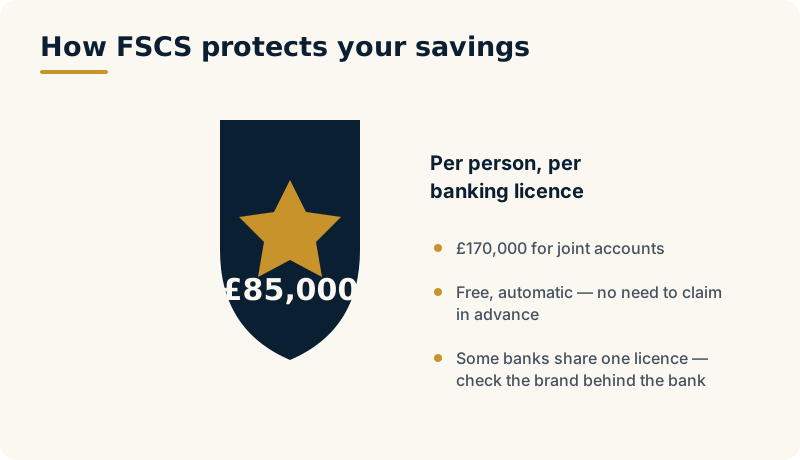
All UK current accounts from authorised banks and building societies are covered by the Financial Services Compensation Scheme (FSCS) up to £120,000 per person per banking group. That cover is what makes a current account fundamentally different from holding money in an unregulated app or e-money wallet.
The five types of current account
Almost every UK current account fits one of these five buckets. Decide which type you need first, then compare on price and features within that type.
- Standard fee-free
Day-to-day banking with no monthly fee. Most adults need nothing more than this.
- Reward / cashback
Pays interest on small balances, cashback on direct debits or a switching bonus. Worth it if you'll actually use the perks.
- Packaged
Pay £10–£20 a month for bundled insurance (travel, breakdown, mobile). Only good value if you'd buy those policies anyway.
- Basic
For people who can't pass a credit check. No overdraft and no cheque book, but full FSCS cover and a debit card.
- Student & graduate
Interest-free overdrafts up to ~£3,000 while studying. The overdraft — not the freebies — is what matters.
How switching works (it really is seven days)
The Current Account Switch Service (CASS) is a free, guaranteed scheme run by Pay.UK. Open your new account, tick the switch box, and within seven working days your direct debits, standing orders and incoming payments move across. Your old account is closed automatically.
If anything goes wrong — a missed direct debit, a duplicate charge, a misdirected payment — the Current Account Switch Guarantee refunds you. Over 9 million switches have completed under it since 2013.
What to compare
Once you know which type you need, ignore the marketing and compare on these five things:
- Arranged overdraft APR
Even 'free' accounts charge ~40% EAR if you dip into the red. If you ever use one, this is the number that matters.
- Switching bonus
Banks regularly pay £100–£200 to switch. Treat it as a one-off — not a reason to stay.
- In-credit interest
A handful of accounts pay 1–5% AER on balances up to £1,500–£3,000. Useful for a buffer; not a substitute for savings.
- Foreign-spending fees
Some banks charge 2.99% abroad; others (Chase, Monzo, Starling, First Direct) charge nothing. Big difference on a holiday.
- App and customer service
Check independent reviews and the FCA's published service-quality tables before opening.
Protecting your money
Spread balances over £120,000 across separate banking groups — not just separate brands. HSBC and First Direct share a banking licence. Corporate group membership alone does not tell you whether two banks share one authorisation. The FSCS website lets you check which brands share a banking licence.
Turn on every fraud control your bank offers: card freezing, gambling blocks, geographic spend limits and instant transaction alerts. Most fraud loss now happens through authorised push payment scams, and almost every major UK bank is signed up to the mandatory reimbursement scheme introduced in October 2024.
Open Banking and account aggregation
Open Banking lets you securely share read-only access to your bank data with regulated third parties — budgeting apps, credit-builder services, savings round-up tools and accountancy software. Consent is granted for 90 days at a time and can be revoked instantly in your bank app.
It's also the technology behind 'pay by bank' checkouts that push money directly from your account without using a card. Cheaper for retailers but, crucially, payments made this way are not protected by Section 75 of the Consumer Credit Act.
The two-account budgeting strategy
A common, free way to control spending is to run two current accounts. Your salary lands in account A. A single standing order on payday moves your committed monthly spend (rent, bills, season ticket, debt repayments, subscriptions) to account B, which pays them all by direct debit. Whatever stays in account A is genuinely yours to spend or save.
Most challenger banks (Monzo, Starling, Chase, Revolut) make this easier with sub-accounts, pots and instant transfer notifications. The structure matters more than the brand.
When the bank gets it wrong: complaints and the Ombudsman
Complain to the bank first, in writing. It has 8 weeks to give you a final response. If you're unhappy, or if it misses the deadline, you can escalate to the Financial Ombudsman Service (FOS) within 6 months. The FOS is free for consumers, legally binding on the bank up to £430,000 (April 2025 award limit), and independent of both the bank and the regulator.
Go deeper on banking
FSCS deposit protection: how the £120,000 limit works
If a covered bank fails, the Financial Services Compensation Scheme can return your eligible deposits without a fee. The standard limit is £120,000 per person, per authorised firm. Work out the total held under each banking licence, including current accounts, savings and Cash ISAs, before deciding where to keep a large balance.
Read the explainer →Should you use the Current Account Switch Service?
The Current Account Switch Service, run by Pay.UK, moves a current account — including direct debits, standing orders and incoming payments — to a new bank in seven working days, with a guarantee if something goes wrong. It is the mechanics behind most UK current-account switches. The decision is whether you actually want the old account closed, not whether seven days sounds convenient.
Read the explainer →Will your bank repay an authorised push payment scam?
Authorised push payment fraud is when a criminal tricks you into sending money yourself. Since 7 October 2024 the Payment Systems Regulator's reimbursement rules give most Faster Payments and CHAPS victims in the UK a legal route back — not a discretionary goodwill payment. The cap is £85,000 per claim. This is a separate scheme from FSCS deposit protection.
Read the explainer →How to choose the best current account in the UK
Banks advertise switching bonuses and cashback to win your custom, but the right current account depends on how you bank, not on the size of the headline offer. This guide explains the main account types, what to compare, and how the free, guaranteed seven-day switch works.
Read the explainer →Overdrafts explained: arranged, unarranged and the real cost
Since 2020 the FCA has forced banks to scrap confusing daily fees and charge a single, advertised interest rate on overdrafts. That made the true cost clearer — and showed how expensive overdrafts really are compared with other borrowing.
Read the explainer →Balance transfer credit cards explained
Balance transfer cards are one of the most effective tools for cutting credit card interest in the UK. You move debt from one or more cards to a new one with a promotional rate — often 0% for a set period. Used well, they can save hundreds of pounds. Used badly, they can leave you with a bigger problem when the promo ends.
Read the explainer →Credit builder credit cards explained
If you have never borrowed, have a thin credit file, or are rebuilding after past problems, mainstream credit cards may reject you. Credit builder cards accept higher-risk applicants but charge higher interest in return. The goal is to prove you can manage credit reliably, not to borrow long-term.
Read the explainer →Overdraft vs credit card borrowing: which costs less?
Banks and credit card lenders both offer ways to borrow, but the costs differ sharply. Since FCA reforms, overdrafts charge a single advertised rate — often near 40% EAR — while credit cards can offer 0% introductory periods. Choosing the wrong product for your timeframe can cost hundreds of pounds.
Read the explainer →Joint bank accounts explained: rights, risks and alternatives
Joint accounts are common for couples, housemates and family members who share household costs. They simplify bill payments but create legal ties: each account holder has full rights over the money and full responsibility for any debt on the account.
Read the explainer →Are premium bank accounts worth the monthly fee?
Premium or 'packaged' bank accounts charge a monthly fee — typically £10 to £25 — in exchange for bundled benefits such as travel insurance, mobile phone cover and airport lounge access. Banks market them as convenient all-in-one packages, but the maths only works if you actually need and use what is included.
Read the explainer →Business bank account basics UK
Trading through a personal account breaches most bank terms and blurs your tax records. Business account fees range from free to around £25 monthly depending on turnover and features. This guide compares startup banking options for sole traders and limited companies.
Read the explainer →UK bank switching bonuses: CASS rules and July 2026 offers
Bank switching bonuses are among the fastest legitimate cash boosts in personal finance. Rules are strict — read criteria before you start, and never switch accounts you rely on for benefits without checking payment timing.
Read the explainer →Moving to the UK: money checklist for your first months
Arriving in the UK means building a financial record from nothing: no UK bank account, no credit history and no tax record. This checklist puts the first money jobs in a sensible order, explains your legal right to a basic bank account, shows how a tax code can take too much from your first pay, and explains what a 'no recourse to public funds' condition means. Rules were checked on 25 September 2026.
Read the explainer →Sending money abroad from the UK: fees, exchange rates and safety
Whether you're supporting family, paying fees overseas or moving savings, an international transfer has two costs, and the one that's easiest to miss is built into the exchange rate. This guide shows how to work out the total cost, how to check a provider is regulated, how your money is protected if a provider fails, and why scam reimbursement rules for UK transfers don't cover international payments. We don't recommend providers.
Read the explainer →
Quick answers on banking
Short, direct answers that link back to this guide and our calculators — useful when you need one rule fast.
- What is the Bank of England base rate today?
- What is FSCS protection?
- How does FSCS banking licence grouping work?
- How do I compare personal loans in the UK?
- What is representative APR on a personal loan?
- Can I check loan eligibility without affecting my credit score?
- What is the difference between secured and unsecured loans?
- Can I repay a personal loan early?
Common questions
- Can I have more than one current account?
- Yes. Most people benefit from at least two: a main account for salary and bills, and a secondary account used purely for budgeting, holiday spending or to keep a switching bonus going.
- Does switching hurt my credit score?
- Opening a new account leaves a hard search on your credit file, which can dip your score by a few points for three to six months. Closing your old account does not damage your score.
- What is the FSCS limit if I hold a joint account?
- FSCS protection is £120,000 per eligible person per banking group. A joint account is treated as £120,000 per holder — so up to £240,000 of joint funds are protected at a single bank.
- Are challenger banks like Monzo, Starling and Chase safe?
- Eligible deposits with a UK-authorised bank can be protected up to £120,000 per person per banking licence, whether accessed through an app or a branch. Check the precise legal entity holding your money: an e-money wallet is different from a protected bank deposit. Use the official FSCS bank and savings checker before depositing.
- Can a bank close my account without telling me why?
- Yes. Banks can close personal accounts with at least 2 months' notice without giving a reason, under the Payment Services Regulations 2017. Immediate closure (without notice) is only allowed if the bank reasonably suspects fraud, money laundering or sanctions breaches. You can complain to the Financial Ombudsman if you think the closure was unfair.
- What's the difference between a debit card and a credit card?
- A debit card spends money you already have in your current account — no borrowing, no interest. A credit card borrows from the card issuer up to an agreed limit, charges interest if you don't clear it in full each month, and gives you Section 75 protection on purchases between £100 and £30,000. The two complement each other; most adults benefit from holding both.